
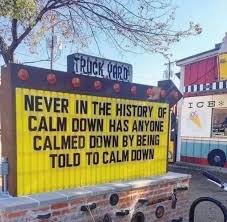
Have you ever been the adult in charge, either as a parent or a teacher, and your student or child is having a total emotional meltdown? Many people tend to respond in one of two ways: deer in the headlights, looking embarrassed that their student/child is doing this. Or respond by telling them to “Calm down!”.
I’m not saying that as a judgment. Generally, we are not taught about human behavior, and certainly not about children’s behavior. We have no reference point when that happens to us as adults, and it’s challenging to know what to do. I’m hoping this blog enlightens some things to give some perspective on this, as well as some tips on what works best.
Has anyone ever told you to “calm down!”? I don’t know about you, but whenever someone has said that to me, it makes me MAD! It’s a comment that’s not meant to actually calm you down, but essentially tell you to shut up and stop reacting in a way that’s embarrassing them or making them feel bad over whatever it is you are reacting to. They want control of the situation and of your reaction.
On the other hand, I get it. As both a parent and a teacher, there have been an unending number of times I have been on the end of being the person who is not having the big reaction, but who is the adult in charge. I know that I have used those words (much to my embarrassment, but we got to keep it real here). You just want the moment to be over and to move on. However, “Calm down!” NEVER works. It actually makes things worse.
I’ve gone through some really big moments with my students over the years. My job as a special education teacher was working with students who, for various reasons, had a hard time emotionally handling a school day, as a more typical student seems to be able to. I said “seems to” because I think that, for the most part, everyone, at every age, is dealing with difficult emotions and situations, but is more able to mask them in their everyday demeanor and interactions. I ran the “behavior classroom”. I worked with students who had some really big challenges in their lives and were unable to mask those big emotions and challenges.
For some students, that could look like a major outburst of anger with yelling, cussing at people, and even throwing things. I worked in middle school, so these were not small people having these big reactions. It could be really scary to be around when the reactions can be so huge and unpredictable. I can tell you with certainty, after many tried and failed “Calm down” attempts, that was not the method that ever worked. It only made the situation bigger.
As a parent, I’ve raised three boys. Tantrums occurred, of course, both at home and out in public, and in the scheme of things, it doesn’t feel that much different than a student having an emotional meltdown. The main difference is that you have only slightly more control over a toddler just because they are physically smaller. Otherwise, “Calm down!” is just as effective in each situation.
So, what do you do when you’re the adult in charge, as a teacher, coach, or parent, and your student or child (of any age) is having a full emotional meltdown? Empathy is always the key.
How does it feel to you when you’re having a really hard moment and someone recognises that, steps up to not only acknowledge that they see you struggling but also does something to help you? That could be as small as “Hey, you look tired. Why don’t you take a break, and I’ll take over getting dinner ready.” Isn’t that amazing when that happens?
Whatever the cause of the big emotions in a child or a student – tired, embarrassed, hungry, stressed, in pain, a triggering event, communication challenges, sensory issues, etc – they have the same need to be seen and helped in those moments. Instead of yelling at them for being unreasonable, just take a moment, acknowledge their feelings, and let them have the time and space to work through them. What is their need at that moment? Not yours, but theirs?
I believe that every single one of us wants to be truly seen by others. To know that someone sees who we are in both our good moments and our really terrible moments, and accepts us for who we are in that moment. That is true at any age.
When someone is going through an emotional storm, the best thing that you can do is to gently let them know you are sorry they are having a difficult moment, so they know you see them struggling, but quietly stay with them to let them ride out the storm in their own time. So no judgement, but “I see you and am here for you”. For smaller kids, helping them identify what they are feeling is also helpful. “Are you tired and hungry? Ok, let’s get that sorted out.”
Either way, your response should be much quieter than theirs. When you respond to someone yelling in a low, quiet tone, it takes a lot of energy and tension out of the interaction. The child having the reaction may start to match that quieter tone as well.
When one of my middle school students had a big emotional moment, I found that most people tended to respond by trying to control those big emotions. They would shame the student, “Behave like an 8th grader!” or tell them to stop, or give a deadline, “in 5 minutes we are going to…” or say “I need you to…”. It never worked. We have all had some huge emotions at times. It feels awful when someone is essentially telling you that your feelings and reactions are ridiculous, and then they tell you why, in their opinion. Or they tell you when you are supposed to be finished with those big feelings. Ugh! The feelings may be big and may be unexpected, but they are very real to that student.
My strategy was to make my voice quieter and to lower my tone to a deeper level. I would also sit down and turn my body to the side so it didn’t feel like I was confronting them in any way. And then I would wait. Eventually, that storm would pass, and the student would be able to get on with their day. Sometimes we would talk about what happened or what they may have been feeling, but other times they just wanted to move on. Generally, they are embarrassed about their reaction and want things to go back to normal. I found that by letting them have the time and support to calm down, without being shamed or hurried, those big moments got less frequent and shorter in duration. Eventually, we would be able to work together to anticipate some challenges and figure out how to mitigate them in advance. It was wonderful to be part of that learning process.
It’s the same for toddlers. At 18 months, my youngest had a monster of a tantrum. It lasted an hour and a half, rolling around, yelling, and crying. Fortunately, we were home, but I used the same strategy. Soft words, turn sideways, and wait it out. Eventually, he fell asleep after wearing himself out. After that, there were no more tantrums and a lot of good opportunities to name the feelings so we could figure out a solution together.
With an empathetic approach, these big reactions can get a lot smaller or even disappear. Soft, low voice, sit down to make yourself smaller and less threatening, and give them time to work it out. Try it out and see if that helps with any toddler tantrums or big student outbursts. Let me know if you see a difference!


 Parenting, Teaching & Coaching with Empathy
Leave a comment